Z’s Approach to Therapy
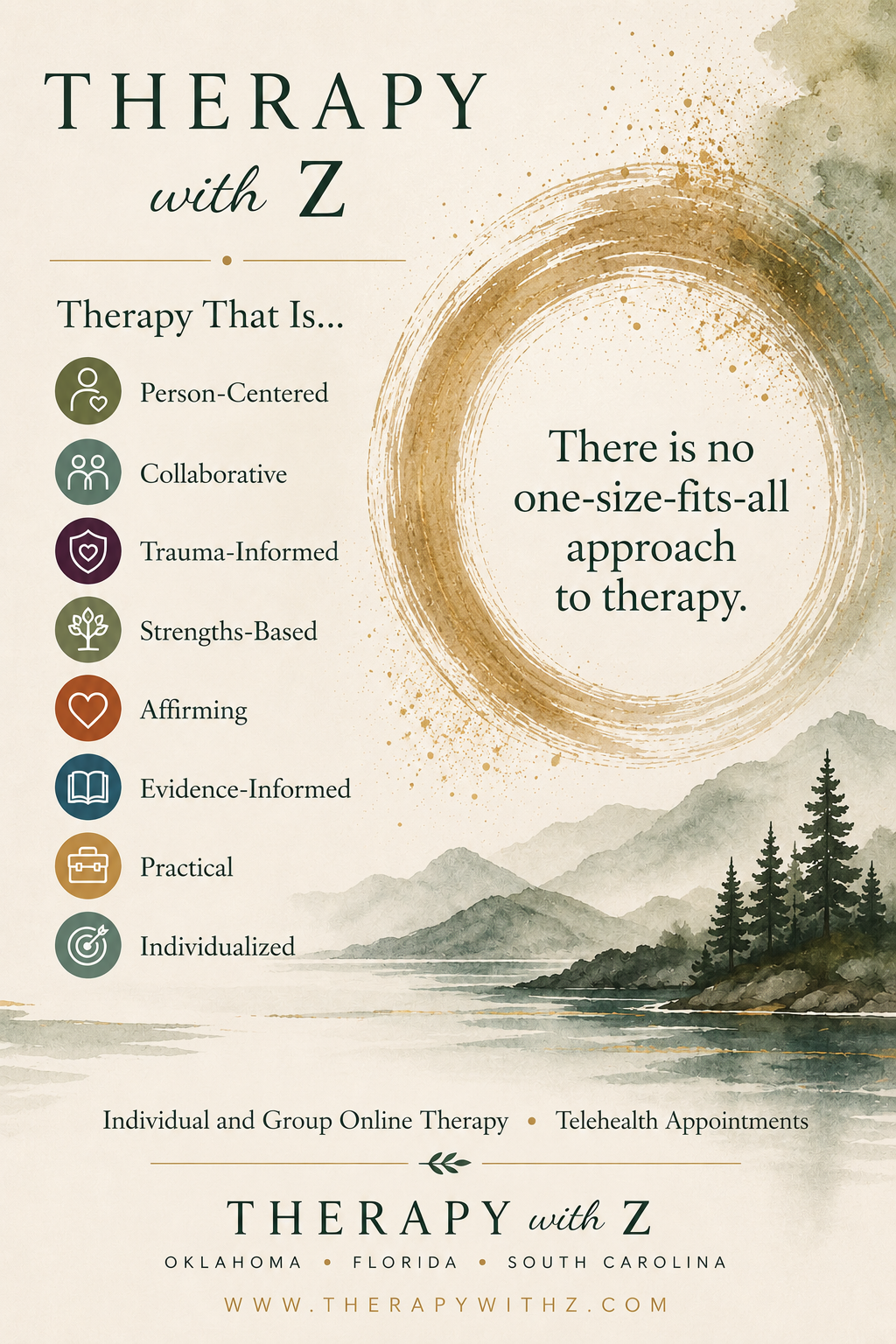
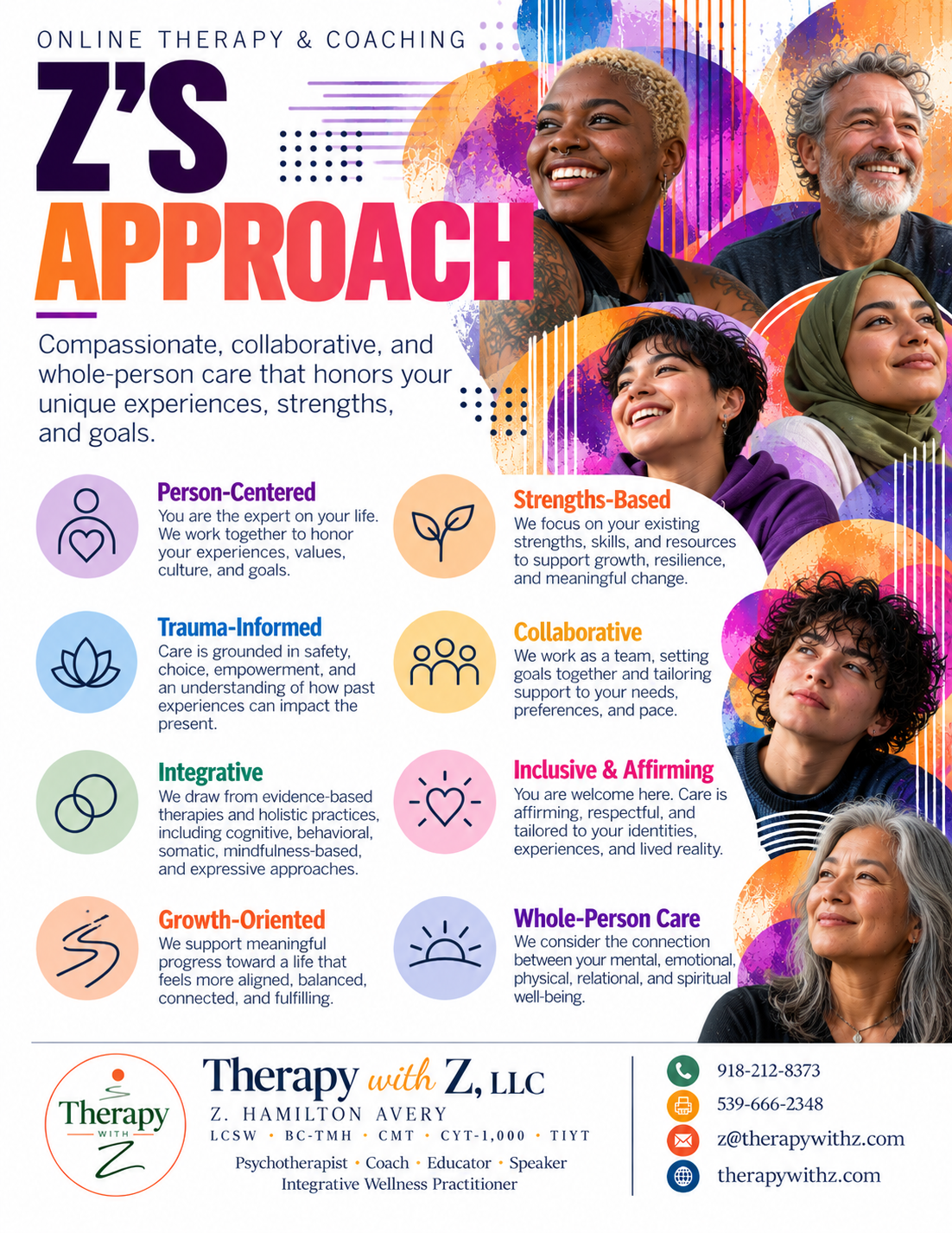
I take an integrative approach to therapy because no single therapeutic model works for every person, concern, or stage of life. My work is humanistic, person-centered, evidence-based, trauma-informed, strengths-based, and responsive to the individual. I also draw from mind-body perspectives to help us understand what you are experiencing and determine what may help.
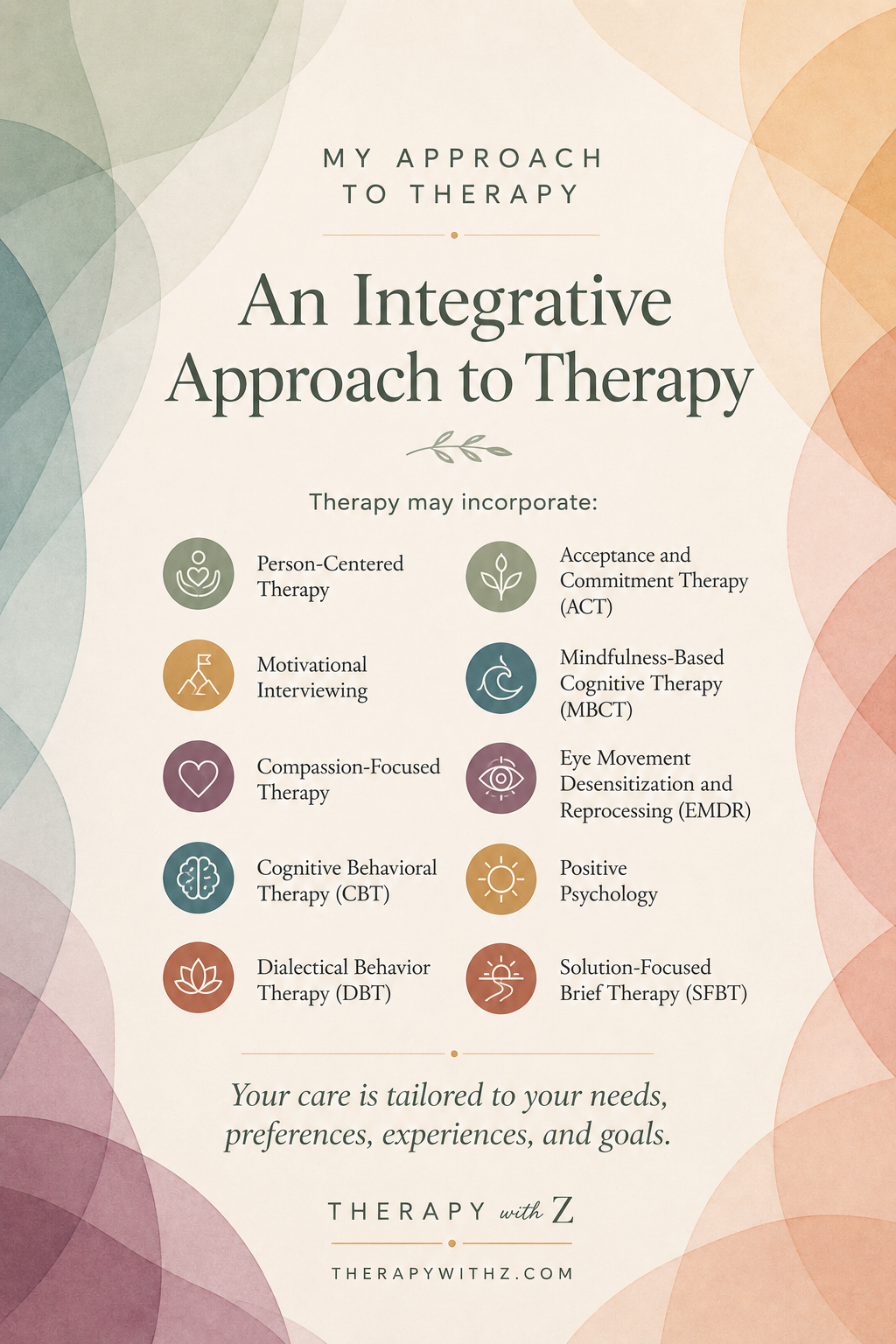
Rather than fitting you into a particular type of therapy, I draw from different approaches based on your needs, goals, experiences, strengths, preferences, and what we learn together throughout treatment. Some sessions may involve deeper reflection and emotional processing. Others may focus more on practical skills, changing patterns, mindfulness, self-compassion, or understanding how thoughts, emotions, behaviors, relationships, and the body interact.
Therapy is collaborative and flexible. I want you to understand the options available to you, why I may recommend something, and what we learn from trying it. What helps and what does not can both give us useful information about you and help guide what comes next.
How I Decide What We Do
Integrative therapy does not mean choosing techniques at random or trying to fit as many approaches as possible into a session. The process begins by getting to know you. We consider what brings you to therapy, what you hope will be different, what you have already tried, what has helped before, what has not, what strengths and resources you already have, and what feels realistic for your life.
I frequently use psychoeducation to help you understand the options available. If I recommend an intervention, I want you to know what we are doing and why. We may discuss the theory behind it, what the research suggests, what it is intended to help with, and what you can expect from trying it. You are encouraged to ask questions, express concerns, disagree, or decide that a particular approach does not fit.
We can treat many interventions as experiments. If something helps, we can explore what made it useful. That can tell us something about your needs, strengths, preferences, patterns, or the ways you respond to change. It can also point us toward related strategies that may be worth exploring.
Something that does not help can be informative too. We can consider what did not fit and use that information to narrow the field rather than continuing to push an approach simply because it works for someone else. Sometimes that requires deeper exploration. Other times, you already know why something was not useful, and we can accept that information and move on.
Therapy also has continuity. We may return to something from a previous session, check in about a skill or strategy you wanted to experiment with, notice what happened between sessions, and use what we learn to determine where we go next.
Evidence Matters
My work is evidence-based and research-informed. I have spent years reviewing peer-reviewed research across psychological, behavioral, complementary, and mind-body interventions. I do not consider one favorable study enough to establish that an approach works, and I do not assume that every intervention has the same amount or strength of evidence behind it.
I look at the broader body of research, including randomized controlled trials, efficacy studies, systematic and literature reviews, meta-analyses, and conclusions from credible professional sources. Some approaches have extensive and well-established evidence bases. Others have smaller, emerging, mixed, or more limited bodies of research. Those distinctions matter.
When the evidence for an approach is still developing or uncertain, I believe you deserve to know that. We can discuss what is known, what is not, the potential benefits or limitations, and the rationale for considering it. You can then make an informed decision about whether it is something you want to explore.
Research should also be understandable. You do not need a background in psychology, statistics, or research methodology to participate meaningfully in decisions about your own care. Part of my role is translating complex information into language you can actually use.
Approaches I Integrate
Person-Centered Therapy
I believe therapy begins with a genuine relationship where you can feel heard, respected, understood, and accepted as a whole person rather than reduced to a diagnosis or collection of symptoms. I bring empathy, curiosity, authenticity, and unconditional positive regard into our work while recognizing that you have meaningful knowledge and insight about your own life.
Therapy is something we do together rather than something I do to you. My role is to create space for you to explore your experiences openly, understand yourself more deeply, recognize what may no longer be serving you, and move toward changes that feel meaningful to you.
Cognitive Behavioral Therapy (CBT)
I use CBT to help us explore connections between thoughts, emotions, behaviors, and experiences. We may identify patterns contributing to anxiety, depression, avoidance, self-criticism, or other difficulties and experiment with different ways of responding.
I do not approach CBT as simply replacing “negative thoughts” with positive ones. Instead, we can slow thoughts down, examine them with curiosity, consider whether they are accurate or useful, and explore how changes in thinking or behavior might affect the larger pattern.
Dialectical Behavior Therapy (DBT)
I integrate DBT when practical skills can help make difficult emotions or situations more manageable. We may draw from mindfulness, emotion regulation, distress tolerance, and interpersonal effectiveness to develop strategies you can use both during and outside of therapy.
DBT can be particularly useful when emotions feel intense, distress is difficult to tolerate, relationships feel complicated, or you need tools for navigating difficult moments. I also value its emphasis on holding acceptance and change together: recognizing where you are now while continuing to work toward where you want to be.
Acceptance and Commitment Therapy (ACT)
ACT helps us shift from trying to eliminate every uncomfortable thought or feeling toward developing a different relationship with difficult internal experiences. We may practice noticing thoughts without automatically treating them as facts, making room for emotions that cannot simply be solved, clarifying what matters most to you, and identifying actions that move your life closer to those values.
ACT creates room for both discomfort and meaningful change without suggesting that difficult emotions mean something has gone wrong.
Mindfulness-Based Cognitive Therapy (MBCT)
MBCT brings together elements of cognitive therapy and mindfulness. I may use it to help you become more aware of thoughts, emotions, physical sensations, and familiar patterns without immediately reacting to them. Rather than becoming caught inside a thought or feeling, mindfulness can create enough space to notice what is happening and choose how you want to respond.
Depending on your interests and needs, this may include meditation, grounding, breath awareness, body awareness, or other mindfulness practices. Mindfulness is an option rather than a requirement. If it does not fit you, your preferences, your beliefs, or what you need from therapy, we can use other approaches.
Compassion-Focused Therapy (CFT)
Self-criticism, shame, and feeling as though you are never doing enough can make change particularly difficult. I draw from compassion-focused therapy to help you develop a more supportive relationship with yourself, particularly when your internal voice has become harsh or punitive.
Compassion does not mean ignoring accountability, pain, or difficult realities. It means learning to respond to suffering and imperfection with greater understanding, courage, and care so that growth does not have to depend on attacking yourself first.
Motivational Interviewing (MI)
Sometimes part of you wants something to change while another part feels uncertain, afraid, exhausted, or simply not ready. I use motivational interviewing to make room for that ambivalence rather than pushing you toward a decision before you are ready.
Together, we can explore what matters to you, what makes change difficult, what might make it worthwhile, and what you want your next step to be. This approach respects your autonomy and recognizes that meaningful change tends to be more sustainable when the motivation for it belongs to you.
Solution-Focused Brief Therapy (SFBT)
Not every problem requires spending months analyzing how it began. Sometimes it is more useful to identify what is already helping, what you would like to be different, and what small changes could move you in that direction.
I draw from solution-focused therapy when a practical, strengths-oriented approach fits the situation. We may identify exceptions to a problem, recognize resources you are already using, define achievable goals, and build on progress that may otherwise be easy to overlook.
Eye Movement Desensitization and Reprocessing (EMDR)
I integrate EMDR principles and interventions into trauma-informed treatment when appropriate. EMDR provides a structured framework for understanding how distressing experiences can remain connected to present-day emotions, beliefs, physical sensations, and reactions.
Trauma work does not have to mean immediately revisiting the most painful experiences in your life. The process begins with understanding your experiences, identifying resources, strengthening coping and stabilization, and determining together when deeper processing may be appropriate. Preparation, safety, pacing, and your ability to remain grounded are important throughout the process.
Principles That Shape the Whole Process
Trauma-Informed Care
Trauma-informed care influences how I approach therapy whether or not trauma is the primary reason you are seeking support. Past experiences can affect the nervous system, relationships, sense of safety, coping strategies, beliefs, and responses to present-day situations.
Rather than focusing only on what is difficult now, I am interested in understanding what happened, how you adapted, what those adaptations may have helped you survive or manage, and whether they are still serving you today. You remain involved in decisions about pacing, boundaries, goals, and what we explore.
Strengths-Based Perspective
Therapy naturally involves talking about what is difficult, but I do not want difficulty to become the only thing we notice about you. A strengths-based perspective helps us recognize abilities, relationships, values, knowledge, coping strategies, accomplishments, and other resources that already exist alongside the concerns bringing you to therapy.
I may ask directly about your strengths, help you identify strengths that are difficult to recognize in yourself, or point them out as they emerge throughout our work. Sometimes treatment involves developing something new. Other times, it involves recognizing capacities you already have and learning how to use them differently.
Mindfulness and Mind-Body Approaches
Mental health does not exist separately from the body. When appropriate and of interest to you, I may integrate mindfulness, meditation, breathing practices, grounding, relaxation, body awareness, gentle movement, or principles drawn from trauma-informed yoga and other mind-body traditions.
These practices can complement psychotherapy by helping you notice physical responses to stress, reconnect with the present moment, regulate emotional and physiological responses, and develop additional ways of responding to distress.
These approaches are always individualized and optional. My background in bodywork, yoga, meditation, and integrative wellness can inform the options available to us without changing the boundaries of psychotherapy. I do not provide massage, acupuncture, Reiki, or other hands-on integrative services as part of psychotherapy. When appropriate, related knowledge may instead inform education or self-directed practices that fit within therapy.
Informed Consent & Client Autonomy
I want you to know what is happening in your therapy and have a meaningful voice in it. Informed consent is not something that happens once when paperwork is signed. It continues throughout treatment.
I explain recommendations, discuss alternatives when appropriate, invite questions, and encourage honest feedback. You can tell me that you do not want to use a particular intervention. You can tell me that something is not helping. You can ask why I am asking a question or recommending an approach.
If I think something deserves additional exploration, I may be curious or offer another perspective, but the goal is collaboration rather than compliance.
Transparency also matters when conversations involve safety, confidentiality, or other clinical responsibilities. I want you involved in decisions affecting your care whenever possible and to understand what is happening throughout the process.
Putting It Together
You do not need to know which type of therapy you need before we begin. Part of my role is understanding the different approaches available and helping determine which ones may be useful for you.
Treatment may draw heavily from one approach or combine elements from several. What we use may also change over time as your needs, circumstances, and goals change.
I want therapy to remain collaborative, flexible, and responsive rather than following a predetermined formula. We can discuss why an approach may be useful, decide whether you want to try it, pay attention to what happens, and use what we learn to guide the next step.
Over time, the goal is not only to identify strategies that help. I want you to understand yourself more clearly, recognize what works for you and why, and develop knowledge and skills you can continue using beyond therapy.
You should not have to fit yourself into the therapy. Therapy should remain responsive to you.