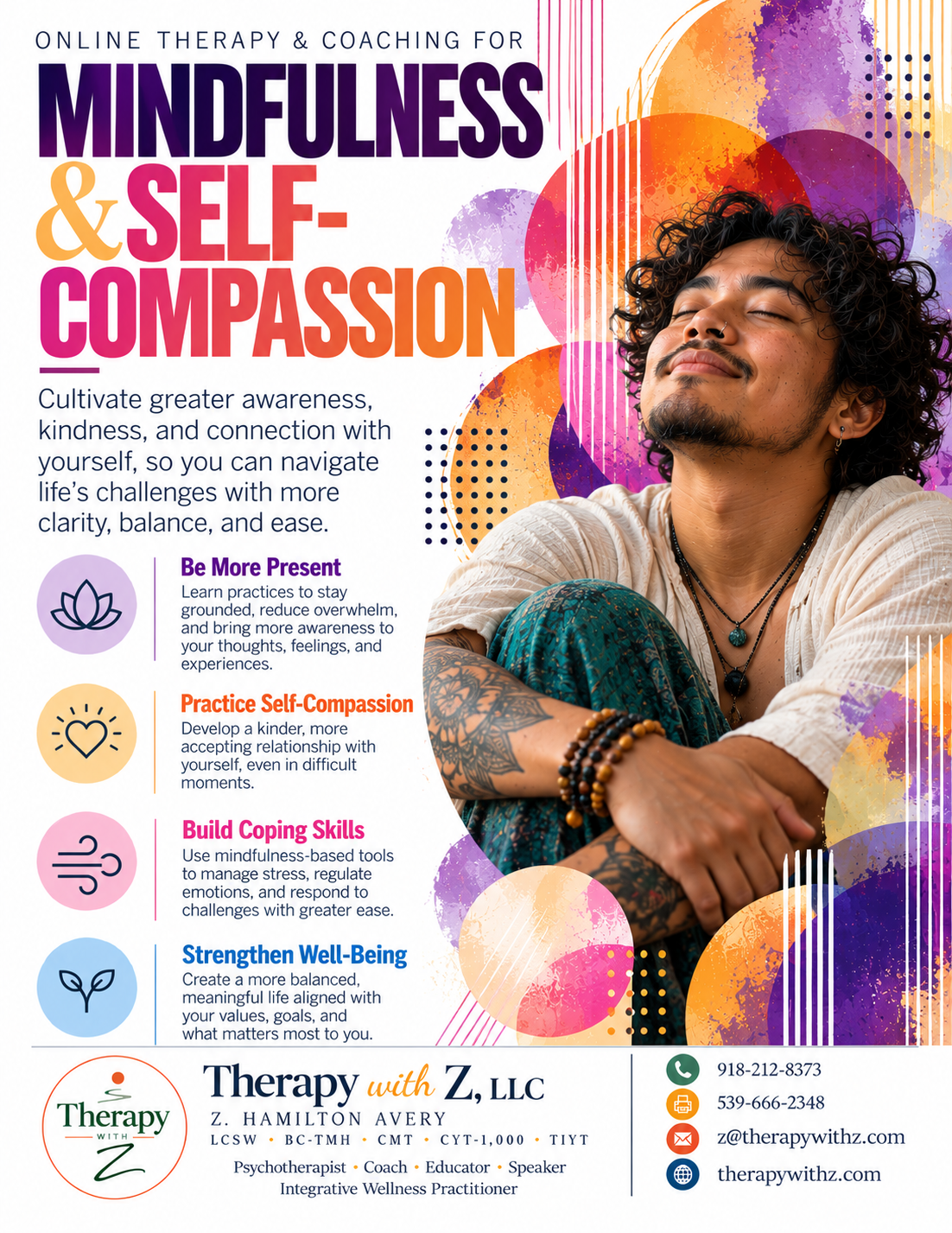
Therapy for Mindfulness and Self-Compassion
It can be difficult to feel at ease when your mind is constantly analyzing, criticizing, anticipating, or replaying what has already happened. Mindfulness and self-compassion can help you develop a different relationship with your thoughts and emotions so you can respond to yourself with greater awareness, flexibility, and care.
Therapy for Mindfulness and Self-Compassion
Support for becoming more present, understanding your inner experience, and responding to yourself with greater compassion.
Many of us become accustomed to moving through life on autopilot. You may spend much of your time thinking about what happened yesterday, anticipating what could happen tomorrow, judging how you handled something, or mentally moving through everything you still need to accomplish. You may also notice that the way you speak to yourself is far harsher than the way you would speak to someone you care about.
Mindfulness and self-compassion offer another way of relating to these experiences. Rather than trying to eliminate uncomfortable thoughts or emotions, therapy can help you notice what is happening, understand your reactions, and choose how you want to respond.
What Is Mindfulness?
Mindfulness involves intentionally bringing attention to your present experience with openness and curiosity. That experience may include thoughts, emotions, physical sensations, surroundings, or whatever is happening in the moment.
The goal is not to stop thinking, empty your mind, or remain calm all the time. Mindfulness can help you notice thoughts without automatically treating every thought as a fact, recognize an emotion without immediately reacting to it, and become aware of what your body or environment may be communicating. It can also help you notice when attention has become caught in worry, rumination, judgment, or distraction.
Mindfulness is a practice of noticing and returning. Your mind will wander. That is part of the practice rather than evidence that you are doing it incorrectly.
What Is Self-Compassion?
Self-compassion involves responding to your own difficulty with care rather than automatically turning toward criticism, shame, or judgment. It does not mean ignoring mistakes, avoiding responsibility, making excuses, or convincing yourself that everything is fine. Compassion and accountability can exist together.
Self-compassion may involve recognizing that something is painful, remembering that struggle is part of being human, and considering what you need in order to respond effectively rather than punishing yourself for having difficulty.
For people who have relied on self-criticism as motivation, this can initially feel unfamiliar. You may worry that being kinder to yourself will make you complacent, less productive, or less likely to change. Therapy can provide space to examine those beliefs and explore forms of motivation and accountability that do not depend on continually attacking yourself.
When Your Inner Critic Takes Over
Self-criticism can become so familiar that it begins to feel like an objective description of who you are.
You may notice thoughts such as:
I should be doing more.
I should be handling this better.
Everyone else seems to have figured this out.
I always mess things up.
I am not good enough.
I should not feel this way.
I need to stop being so sensitive.
If I am not hard on myself, I will never improve.
These patterns can contribute to shame, stress, anxiety, depression, perfectionism, avoidance, burnout, and difficulty recognizing or responding to your own needs.
Therapy can help you notice self-critical patterns without simply replacing them with positive thoughts you do not believe. We can explore where these patterns come from, what they may be trying to accomplish, how they affect you, and whether there are more accurate, flexible, and compassionate ways to respond.
Mindfulness Is Not About Being Calm All the Time
Mindfulness is sometimes presented as a relaxation technique or a way to make uncomfortable feelings disappear. Relaxation can occur, but that is not always what mindfulness does.
Being present may mean noticing sadness, anger, fear, frustration, grief, uncertainty, physical discomfort, or other experiences you would rather not be having. Mindfulness can create space to observe what is happening without immediately becoming consumed by it or automatically trying to push it away.
Sometimes mindfulness leads to calm. Other times it helps you recognize what is happening clearly enough to make a more intentional choice about what comes next. The goal is not constant calm. The goal is greater awareness and flexibility.
How Therapy May Help
Mindfulness and self-compassion can be integrated into therapy in practical ways based on your needs, preferences, values, and goals.
Therapy may help you:
become more aware of thoughts, emotions, and physical sensations
recognize patterns of self-criticism and shame
reduce rumination and overthinking
respond differently to difficult thoughts
develop greater emotional awareness
practice self-compassion during periods of distress
reduce perfectionistic expectations
become more comfortable with uncertainty
identify what you need without immediately judging yourself for needing it
develop healthier ways of responding to mistakes or setbacks
increase awareness of personal values and priorities
become more intentional about how you respond to difficult situations
practice being present during ordinary moments
develop mindfulness practices that feel realistic and sustainable
Mindfulness and self-compassion are not requirements for therapy. They are tools that can be adapted, modified, or set aside depending on what is helpful for you.
An Individualized and Integrative Approach
My approach is humanistic, person-centered, strengths-based, trauma-informed, collaborative, and integrative. Mindfulness and self-compassion are not prescribed as universal solutions. We can consider whether these approaches fit your needs, values, preferences, culture, beliefs, and goals before deciding how or whether to incorporate them into therapy.
Depending on your needs and goals, our work may draw from person-centered therapy, MI, CBT, DBT, ACT, CFT, MBCT, mindfulness, somatic and mind-body practices, behavioral strategies, and other evidence-based and research-informed approaches. Mindfulness and compassion appear within several therapeutic traditions, but different practices serve different purposes.
Mindfulness may involve formal meditation, but it does not have to. Practice might involve attention to thoughts, emotions, physical sensations, movement, the environment, sensory experiences, or ordinary activities. Self-compassion may involve exploring self-talk, responding differently to difficult emotions, examining beliefs about self-criticism and motivation, or practicing more supportive ways of relating to yourself.
If I suggest a practice, I will explain why I think it may be useful and what we are trying to accomplish. You can ask questions, modify the practice, decline it, or tell me that it does not fit. We can use your response as information about what may be more useful instead.
Mindfulness, the Body, and the Present Moment
Mindfulness can include paying attention to physical sensations as well as thoughts and emotions. You might notice tension, changes in breathing, restlessness, fatigue, warmth, discomfort, movement, or other sensations that provide information about your current experience.
Body awareness can sometimes help you recognize stress or emotional activation earlier. It can also be uncomfortable, inaccessible, or counterproductive for some people. For people living with chronic illness, persistent pain, disability, panic symptoms, trauma, or difficult relationships with their bodies, focusing internally may require particular care.
Mindfulness does not require you to override physical discomfort or remain focused on sensations that increase distress. Practices can be adapted to emphasize external awareness, movement, sensory information, shorter periods of attention, or other approaches that better fit your body and current needs.
Trauma-Informed Mindfulness
Mindfulness is not automatically comfortable or appropriate simply because it is commonly recommended. For some people with histories of trauma, closing the eyes, focusing internally, becoming still, concentrating on the breath, or reducing awareness of the surrounding environment can increase discomfort or feelings of vulnerability.
Trauma-informed mindfulness emphasizes choice, flexibility, pacing, and attention to what feels safe enough for you. You may prefer to keep your eyes open, orient toward your surroundings, focus on something outside your body, move instead of sitting still, practice for shorter periods, or use grounding rather than meditation.
There is no single correct way to practice mindfulness. If a particular practice makes it more difficult for you to remain present or engaged, we can change it rather than assuming you need to try harder.
Self-Compassion Is Not the Same as Self-Esteem
Self-compassion does not require deciding that you are better than other people, convincing yourself that you are exceptional, or maintaining a positive evaluation of yourself at all times. It is a way of responding to yourself when you are struggling, disappointed, embarrassed, hurting, or aware that you have made a mistake.
This distinction can matter when positive affirmations or attempts to improve self-esteem feel artificial or difficult to believe. Rather than requiring a particular judgment about your worth or performance, self-compassion asks how you can respond to yourself with greater understanding while still making room for responsibility, growth, and change.
For some people, learning to respond differently to mistakes and perceived inadequacy can reduce the cycle in which self-criticism creates additional distress, which then becomes another reason for self-criticism.
Therapy Across Different Stages of Life
Mindfulness and self-compassion can be useful across different stages of life, but the reasons for using them and the way they are practiced may look different.
Adolescents may use these skills while navigating emotions, school pressure, relationships, identity development, self-esteem, or social comparison. Adults may find them useful for stress, perfectionism, relationships, work demands, parenting, caregiving, health concerns, or major transitions. Older adults may explore mindfulness and self-compassion while navigating health changes, grief, caregiving, retirement, changing roles, relationships, or questions about meaning and purpose.
I provide therapy for adolescents age 13 and older, adults, and older adults. Practices are adapted to your developmental needs, circumstances, preferences, abilities, and goals rather than assuming the same exercise will work for everyone.
Mindfulness and Self-Compassion for Stress, Anxiety, and Depression
Mindfulness and self-compassion can be incorporated into treatment for many different concerns. With anxiety, mindfulness may help you recognize worry without automatically following every anxious thought. With depression, self-compassion may help address patterns of shame, hopelessness, and harsh self-judgment. During periods of stress or burnout, these practices may help you notice limits, recognize needs, and respond before exhaustion becomes more severe.
They may also be incorporated into therapy for trauma, grief, chronic illness, persistent pain, emotion regulation, identity concerns, relationship difficulties, and major life transitions. Their usefulness depends on the person, the concern being addressed, and how the practice is implemented.
The goal is not to use mindfulness or self-compassion to avoid difficult experiences. It is to develop greater capacity to remain connected to yourself, understand what is happening, and respond more intentionally as you move through them.
Online Therapy for Mindfulness and Self-Compassion
Online therapy can provide opportunities to practice mindfulness and self-compassion in the environment where you spend your everyday life. Skills explored during sessions can be connected directly to routines, spaces, relationships, and situations you encounter outside therapy.
Therapy with Z provides online psychotherapy for adolescents age 13 and older, adults, and older adults in Oklahoma, Florida, South Carolina, and Idaho. You must be physically located in a state where I am authorized to provide psychotherapy at the time of your appointment.
Visit the Online Therapy and Telehealth page for current availability and more information about virtual sessions.
Frequently Asked Questions
Do I have to meditate to practice mindfulness?
No. Meditation is one way to practice mindfulness, but it is not the only way. Mindfulness can be practiced through movement, sensory awareness, eating, walking, listening, breathing, or intentionally paying attention during everyday activities.
What if I cannot stop my thoughts?
You do not need to stop thinking in order to practice mindfulness. Minds think. Mindfulness involves noticing what your mind is doing and practicing how you direct or redirect your attention rather than trying to prevent thoughts from occurring.
Is self-compassion the same as letting myself off the hook?
No. Self-compassion does not require avoiding accountability or ignoring the consequences of your actions. You can recognize a mistake, take responsibility, repair harm when appropriate, make changes, and still choose not to shame yourself in the process.
What if being mindful makes me more anxious?
Some mindfulness practices can increase awareness of uncomfortable thoughts, emotions, memories, or physical sensations. This may be particularly important for people with trauma histories, panic symptoms, chronic pain, or other experiences that can make internal attention difficult.
We can modify or discontinue practices rather than assuming discomfort means you are practicing incorrectly. Grounding, movement, external awareness, shorter exercises, keeping your eyes open, or other approaches may be a better fit.
Can mindfulness help with overthinking?
Mindfulness may help you recognize when you have become caught in rumination, worry, or repetitive thinking. Rather than trying to force thoughts away, you can practice noticing what is happening and choosing whether to continue engaging with the thought or redirect attention toward the present or an action that matters to you.
Do I need previous experience with mindfulness?
No. You do not need any experience with mindfulness, meditation, yoga, or other contemplative practices to begin. We can start with what you already know about yourself and explore practices gradually if they are relevant to your goals.
You Do Not Have to Fight Yourself to Grow
Growth does not require constant self-criticism. Mindfulness can help you notice your experience more clearly, while self-compassion can help you respond to that experience with greater care. Together, they can create more space between what you think or feel and what you choose to do next.
Therapy can help you develop these capacities in ways that fit your life rather than expecting you to become perfectly mindful, endlessly positive, or calm all the time.